Living Below Grade: A Diagnostic Guide to Damp and Ventilation in Belgian Basement Flats
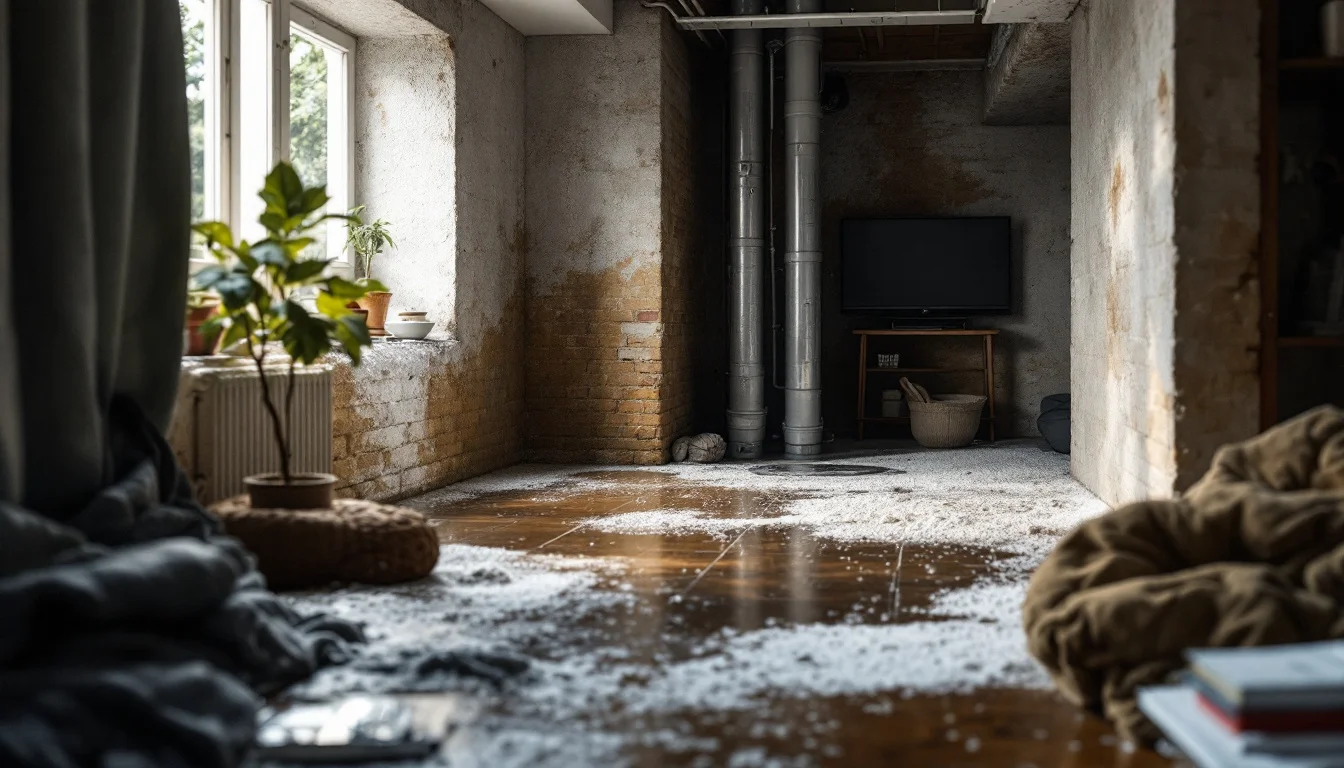
Living Below Grade: Why Basement Flats Need a Different Diagnosis
A basement or semi-basement flat sits partly or wholly below street level, and that single fact changes how moisture behaves inside it. Above ground, a damp patch usually has one plausible cause. Below grade, the same patch can be condensation, rising damp, a cold bridge, or water migrating from a neighbour upstairs — sometimes two or three at once, each needing an opposite fix.
This guide focuses narrowly on damp and ventilation: how to recognise which mechanism is at work and what actually resolves it. Natural daylight access in below-grade flats is a separate structural and urban-planning question, shaped by window wells, sidewalk grates and local building rules, and it falls outside what this article can responsibly cover here. What follows is a diagnostic sequence, not a shopping list for gadgets.
Key Takeaways
- In Belgian homes, insufficient ventilation is described as by far the largest cause of condensation, according to Protector, a Belgian damp and basement waterproofing specialist.
- Rising damp is a distinct mechanism: it travels upward from the ground by capillary action, producing marks that start at floor level and often salt efflorescence or peeling plaster near the base of a wall.
- Left untreated, prolonged condensation can progress to mould growth, wood rot, health problems and structural damage.
- Mechanical ventilation is one structural solution for persistent condensation, alongside insulating cold surfaces, maintaining baseline heat and reducing moisture sources — a dehumidifier only manages the symptom.
- Basement flats routinely combine several of these mechanisms at once, which is why a single fix rarely works on its own.
Why Below-Grade Flats Trap Moisture: The Building Physics
Condensation happens when warm, humid indoor air meets a surface cold enough to cool it below its saturation point, turning invisible water vapour into visible droplets. Protector's own worked example is useful here: at 21°C and 60% relative humidity, the dew point — the temperature at which air can no longer hold its moisture as vapour — sits at around 13°C. Any surface at 13°C or colder, typically a window pane or an external wall section, will start to condense.
This is where basement geometry changes the arithmetic. A wall or window reveal above ground loses heat mainly to open air, and in a heated room it often stays comfortably above the dew point threshold. A basement wall backed by earth, or a semi-basement window reveal sitting partly below pavement level, can lose heat quite differently depending on insulation, depth, soil moisture content and the presence of thermal bridges: in some scenarios soil conducts heat away from the structure and partly buried elements behave like built-in cold bridges, though at sufficient depth the ground can in fact be milder than outdoor air in winter, so an earth-backed wall is not automatically colder than an above-ground one. Where the unfavourable scenario does apply, earth contact and reduced solar gain can narrow the margin between the internal surface temperature and the dew point described above, so a surface that would otherwise sit safely clear of that threshold can instead sit close to or below it. The practical effect, in that scenario, is that the same room air crosses into condensation more often across a heating season, without the indoor humidity itself having changed at all. This is a qualitative description of a possible dew-point relationship, not a measured reading from a specific property.
Two further mechanisms compound this, both documented for flats in the United Kingdom rather than measured in Belgian buildings, and offered here as an explicit comparison rather than a local finding. Flats in general tend to suffer worse condensation than houses because they combine less effective natural ventilation, a higher moisture load per cubic metre of air, and colder internal surfaces, according to Nordic Damp Proofing, a UK damp-proofing company. Many flats are also single-aspect, meaning only one façade is exposed to outside air, which limits cross-ventilation, and internal kitchens or bathrooms without an outside wall depend entirely on mechanical extraction to clear moist air. Semi-basement flats are very often single-aspect by design, since the rear or side walls sit against earth or a neighbouring structure. Concrete floor slabs, balcony junctions, uninsulated lintels and window reveals are flagged as classic cold-bridge locations that sit at or below the dew point — and a basement flat is, structurally, built around exactly this kind of concrete-and-earth junction.
Condensation, Rising Damp, or Something Else? A Diagnostic Framework for Basement Flats
Before fixing anything, the practical question is which mechanism — or combination — is producing the damp patch in front of you. Four patterns are worth separating before attempting any fix.
| Type | Typical location / signs | Timing | Source mechanism | Correct first fix |
|---|---|---|---|---|
| Condensation | Glass, cold external walls, corners, behind furniture | Mainly mornings, worse in winter | Warm humid air meeting a cold surface | Improve ventilation and baseline heating |
| Rising damp | Floor level upwards; salt efflorescence, peeling plaster at the base | Constant, not seasonal | Groundwater drawn up through the wall by capillary action | Investigate the damp-proof course / wall base, not the air |
| Penetrating damp | Localised patches linked to an external wall, roof or window | Follows rain events | Water entering from outside through a defect | Trace and repair the external entry point |
| Inter-flat / communal leak | Ceiling, shared walls, pipe runs; appears without an obvious outside cause | Irregular, often sudden | A plumbing or building-envelope defect in a neighbouring unit or communal area | Check with the building manager or neighbouring unit before assuming condensation |
The fourth row matters more than it first appears: in blocks of flats, damp can originate in a neighbour's plumbing or in a communal defect, so recurring patches that look like condensation deserve a check of the source before any ventilation work begins. It is also worth noting that some building surveyors and conservation specialists caution that true capillary rising damp is diagnosed more often than it actually occurs, and that look-alike symptoms — salt staining or peeling plaster near floor level — can equally result from condensation or penetrating water pooling at low level. This argues for comparative moisture measurement rather than visual inspection alone before agreeing to any invasive wall treatment.
A basement or ground-floor flat is also simply colder and more humidity-prone as a category, a pattern UK guidance associates with rising damp risk in below-ground units and with rain ingress around roofs and windows more generally. One UK building-regulations document, Approved Document F, is cited by UK damp-proofing industry sources as stating that its standard natural-ventilation guidance is not appropriate for a dwelling that is only a basement — a claim this article has not independently verified against the primary regulatory text, but which, if accurate, treats below-grade units as a distinct case in UK practice. No Belgian figure of this kind appears to exist — if you want the local standard for your situation, that is a question for a certified assessor or a Confederatie Bouw member, not a generic online checklist.
What Actually Works (and What Doesn't)
Fixing condensation starts with understanding how much moisture a household actually produces. Protector's figures describe roughly 0.5 to 1 litre of moisture released per person overnight from breathing and sweating while asleep, sometimes rounded to about 1 litre in its own materials, and a further 2 to 3 litres released into the air simply from drying laundry indoors. In a basement flat with limited air exchange, that moisture has fewer places to go, which is part of why laundry habits matter more below grade than in a well-ventilated upper-floor flat.
Temperature matters as much as ventilation. RICS, the UK's professional body for surveyors, is cited (via UK damp-proofing industry sources) as recommending that internal heat be kept ideally at 18–21°C to reduce condensation and mould risk — a useful reference point, though it reaches this article secondhand and is a UK benchmark rather than a Belgian standard. Protector's Belgian material makes the same point in less numerical form, describing sufficient baseline heat as part of preventing condensation.
On remediation, a Belgian specialist and an unrelated UK industry body reach the same conclusion independently. Protector states that a dehumidifier can help during peak periods or temporary issues but does not solve the underlying cause of condensation. Nordic Damp Proofing, citing the Property Care Association, describes dehumidifiers as able to manage airborne moisture in the short term without resolving the causes of condensation problems. Two unconnected sources, serving different national markets, arriving at the same caveat is a reasonable signal that this is a structural limitation of the device rather than a sales objection from either firm.
Protector, a commercial damp-proofing specialist, describes mechanical ventilation — extraction or balanced ventilation that continuously replaces humid indoor air rather than merely filtering moisture out of air that keeps regenerating it — as the only structural solution for persistent condensation. That claim should be read as one supplier's position rather than a technical consensus: insulating cold walls, maintaining adequate baseline heating, reducing moisture sources at their origin, and addressing thermal bridges can also durably correct condensation, often alongside rather than instead of ventilation. Where mechanical ventilation is installed, Protector cites installation typically taking one to three working days depending on the property — a useful planning figure for anyone weighing it against a season of recurring damp patches.
When to Stop Guessing and Call a Professional
According to Protector, Belgian homes report condensation peaks between November and March, which is also when a basement flat's colder surfaces are most likely to sit at or below the dew point described earlier. This is the window in which small, manageable damp becomes a larger problem: prolonged condensation can progress to mould growth, wood rot, health problems and structural damage, and a basement unit's constant ground contact means several of these risks can advance quietly behind furniture or under flooring.
When a hygrometer and behavioural changes aren't resolving the pattern, the next step up is a proper survey rather than another product. Diagnostic techniques used for damp in flats include humidity logging with a hygrostat, moisture profiling across a wall, thermal imaging to locate cold surfaces, minimally invasive borescope checks into cavities, and timber checks where rot is suspected. Historic England, cited by industry sources, warns that time and money can be wasted when damp is not properly diagnosed first, and that remedial work carried out against the wrong diagnosis can make the underlying problem worse rather than better.