Lime Mortar vs Cement Mortar: Which to Use on Old Masonry
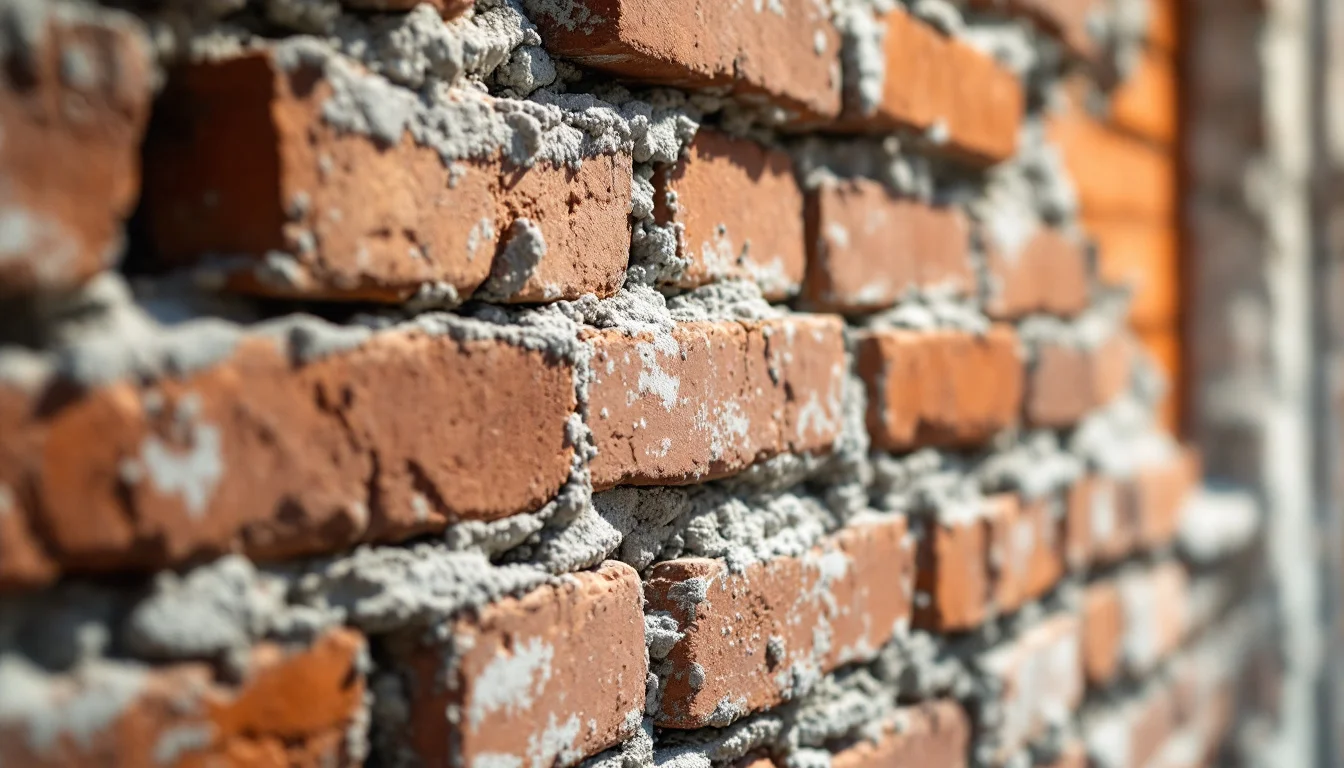
A repointing job can look perfect for decades and still be wrong. Hard Portland cement mortar pressed into joints built for something softer often holds its colour and shape for twenty or thirty winters. Eventually, one winter, after decades of accumulated damage, the brick faces start flaking off in sheets. By the time an owner notices, the mortar that caused the problem is long finished and largely forgotten — it still looks almost new, grey and intact, while the brick around it crumbles.
That delay is the reason so many people blame the age of the brick instead of the repair. The real question for anyone repointing an old wall is not whether lime or cement is the better material in general. It is whether the new mortar matches the hardness and breathability of what is already holding the wall together.
Why mortar is meant to be the weak link
Masonry walls are built on a deliberate hierarchy of toughness. Brick is the expensive, durable layer meant to last. Mortar is the joint filler between the bricks, and it is supposed to be the softer material — the one that wears, cracks and gets renewed over time instead of the brick.
In a wall built with lime mortar, that hierarchy works as intended. Lime mortar is a mix of lime, sand and water, and it has long been the standard binder in historic masonry construction, according to Limeworks, a US lime mortar manufacturer. Its lower hardness is not a defect; it is the design feature that keeps the brick intact for centuries while the joint itself takes the damage from weather, movement and age.
Replace that soft joint with a hard, dense cement mortar and the hierarchy flips. The mortar stops being the sacrificial part. The brick — often older, softer and more porous than modern brick — becomes the weakest material in the wall by default, even though nothing about the brick itself has changed.
How a hard joint turns into a damaged brick face
The mechanism behind that reversal runs through moisture and temperature, and it takes two separate paths that reinforce each other.
The first path is water. Lime mortar is breathable: it lets moisture that gets into the wall travel back out through the joint to the open air, rather than staying trapped inside, according to Limeworks. A dense cement joint slows that exit route dramatically. Water still enters the wall — through rain, condensation or rising damp — but it can only leave through the mortar much more slowly, so a greater share of it works its way out through the brick face instead, as described by Fortune Restoration, a Chicago-based restoration contractor.
Once that water sits in the brick face through a cold spell, it freezes. Ice expands, and the pressure pops off thin layers of the brick surface — a failure pattern known as spalling, per Fortune Restoration's description of the mechanism.
The second path is thermal movement. Brick expands slightly in summer heat and contracts in winter cold. A lime joint flexes with that cycle. A cement joint, being far more rigid, does not move with the brick, so the stress concentrates at the brick's edges instead of being absorbed by the mortar, according to Fortune Restoration. Limeworks makes the same point in terms of flexibility: being more pliable than brittle cement mixes, lime mortar deforms along with the brick's movement rather than resisting it, which reduces cracking.
Neither path alone is dramatic in year one. Repeated over twenty or thirty winters, both quietly erode the brick face while the cement joint itself stays visually unchanged.
Why is Chicago's brick failing decades after it was repaired?
Chicago's older brick stock offers a clear, regional illustration of how this plays out at scale — a pattern specific to that city's building history rather than a universal rule, but instructive for understanding the timeline involved.
Between the late 1890s and 1930, Chicago's brick boom produced close to 700 million bricks a year from more than 50 brickyards, according to a Block Club Chicago report cited by Fortune Restoration. Builders of that era were selective about where each grade of brick went: harder, denser face brick and limestone were reserved for street-facing facades, while softer, more porous common brick went on side, rear and gangway walls that were never meant to be seen up close. That original choice still shows up today — gangway and rear walls tend to fail first, because they were built with the more vulnerable brick to begin with, per Fortune Restoration.
The mismatched repairs came later. Most of the incompatible cement repointing on Chicago's older buildings dates to a wave of post-war renovation between the 1950s and 1980s, when cement-rich mortar had become the everyday standard and "harder" was widely assumed to mean "better," according to Fortune Restoration.
The consequence is the delayed-failure pattern that gives this whole topic its urgency: damage from an incompatible cement repair can take twenty to thirty winters to become visible, so by the time brick is visibly flaking, the repointing job that caused it is old enough to have been forgotten, per Fortune Restoration.
Can lime mortar repair itself?
Lime mortar has one further property that reinforces why it suits movement-prone old walls: it can partially repair itself. Limeworks explains the chemistry side of this — free, or "available," lime within the mortar can dissolve into solution when a crack opens, then re-crystallise across the fissure as a kind of mineral bridge.
Fortune Restoration describes the same phenomenon from the field, independently of the chemistry explanation: water moving through a fine crack in a lime joint dissolves a small amount of lime and redeposits it as the joint dries, gradually closing small cracks over time. Cured cement mortar can show some limited self-healing of fine cracks too, through residual hydration or carbonation, but far less effectively than lime mortar, so a cracked cement joint typically remains open far longer.
That self-healing behaviour helps explain the durability claim that otherwise sounds surprising for a "soft" material: correctly applied lime mortar can last for centuries, and many grand historic masonry buildings built with it remain in service today, according to Limeworks.
How do I know if my wall has cement or lime mortar?
Before repointing any section of old brick, the practical task is identifying what is already there, not deciding in the abstract between lime and cement. Fortune Restoration's field protocol gives four checks that do not require a laboratory.
- Look and colour. Original lime mortar is typically soft, sandy in texture and buff or off-white. Portland cement mortar is harder, grey and noticeably smoother.
- Scratch test. Drag a key or a steel nail across the joint. Lime mortar gives way easily, producing a sandy powder. Cement resists the scratch and the key tends to skate across the surface, sometimes leaving a thin metal streak. Test several joints rather than one, since weathered lime can feel deceptively hard right at the surface.
- Joint profile. In a wall with a bad cement repair, the joints often stand proud like raised grey ridges, while the brick between them is visibly scooped out. That is the reverse of normal wear, where the joint — not the brick — should be the part that erodes first.
- The classic visual signature. Brick faces flaking off in sheets right next to cement joints that still look almost new is the single most recognisable sign of an incompatible repair, per Fortune Restoration.
Why do the same bricks that flake also show white salt staining?
Efflorescence — the chalky white staining that sometimes appears on brick faces — is not a separate problem from the moisture mechanism described above. It is the visible half of the same process.
Limeworks points to a chemical reason lime tends to avoid this damage: Portland cement contains tri-calcium aluminates that react specifically with sulfate salts, forming expansive compounds, while lime is described by the manufacturer as lacking these compounds and therefore less vulnerable to that kind of salt attack from sources such as sea mist or salts already present in the wall core. That is a manufacturer's characterisation rather than an independently verified standard, but it matches what shows up on buildings in practice.
Fortune Restoration's field observation closes the loop: the water forced through the brick face carries dissolved salts with it, which crystallise on the same faces that are already spalling. The white staining and the physical damage are two symptoms of one blocked moisture path, not two unrelated issues.
What mortar should I use to repoint old brick?
The practical rule that follows from all of this is simple to state and easy to get wrong: repoint with a mortar similar in hardness and composition to what is already in the wall. Swapping a historic lime joint for a modern cement one risks trapping water in a wall that was never built to handle it, and can make existing salt problems worse rather than better, according to Limeworks.
In the United States, masonry mortar is graded by letter — S, N, O and K — according to minimum compressive strength, a classification system that Fortune Restoration attributes to a masonry trade group and that is useful mainly for showing how wide the hardness gap actually is:
| Mortar type | Approximate minimum strength | Typical fit |
|---|---|---|
| Type S | ~1,800 psi (roughly 12 MPa) | usually too hard for old, soft brick |
| Type N | ~750 psi (roughly 5 MPa) | often a safer default on historic brick |
| Type O | ~350 psi (roughly 2.4 MPa) | suited to soft, porous brick |
| Type K | ~75 psi (roughly 0.5 MPa) | very soft, historic lime-rich range |
These figures are reported by a US restoration contractor citing an industry trade group, rather than checked here against the original standard, and the letter system itself is an American convention. For a Belgian or wider Western European wall, the equivalent decision point is usually framed around natural hydraulic lime (NHL) products rather than the S–N–O–K letters — and the same underlying logic applies. Limeworks' guidance captures it well: Type S is often too dense for historic brick, Type N is a reasonable middle ground, and very soft original brick may call for something gentler still, down to an O-type mix or a lime-only mortar such as NHL 3.5. The goal in every case is the same — match the new joint to the wall's existing softness, not to whatever happens to be strongest at the merchant.
One workmanship detail matters as much as the mortar choice itself: power grinders used to cut out old joints can wander off-line and chew into the brick edges, widening the joint and damaging brick that the repointing was meant to protect, according to Fortune Restoration. A careful hand-raked joint, even if slower, avoids adding new damage to a wall that is already being repaired for old damage.
Common questions
Can a cement-repointed wall be fixed once the brick starts flaking? The damaged brick faces themselves cannot be restored once they have spalled off, but the cement joints that are causing the ongoing damage can be cut out and replaced with a compatible mortar to stop further loss. A lab mortar analysis beforehand helps ensure the replacement actually matches the original binder rather than introducing a second mismatch.
Does every old building have a lime-mortar problem waiting to happen? No. Only sections that were repointed with incompatible cement mortar are at risk from this specific mechanism. Walls still pointed in their original lime, or walls already repointed with a compatible soft mortar, do not show this failure pattern regardless of their age.
Is softer mortar always the safer choice? Not automatically — mortar that is far softer than the brick it sits against can wear away too quickly and need re-pointing sooner than necessary. The strength range runs wide: Type S mortar is rated around 1,800 psi, Type N around 750 psi, Type O around 350 psi and Type K as low as 75 psi, so "softer" only makes sense relative to what the brick itself can tolerate, not as an absolute good. Portland cement's real advantages show up elsewhere — in high-strength applications like bridges, roads, dams and skyscrapers, and in jobs that need a fast set — rather than in repointing old, soft brick. The aim for historic masonry is a mortar close in hardness to the existing brick and mortar, not simply the softest option available.
The long lag between an incompatible repair and its visible damage means the mortar someone sees failing today was very likely chosen for reasons that made sense decades ago, when harder materials were assumed to be an improvement. That delay is also what makes a quick scratch test and a close look at the joint profile worth doing before any repointing starts, rather than after the next winter has already taken another layer off the brick.